
Spot-clean today without opening the front. Side panel only, long tweezers. Time it — under three minutes is the target.
A weekly cage clean that does not stress the animal.
Spot-clean every day, deep-clean every fourteen days. The animal stays in the cage for the spot-clean and only steps off for the deep-clean.
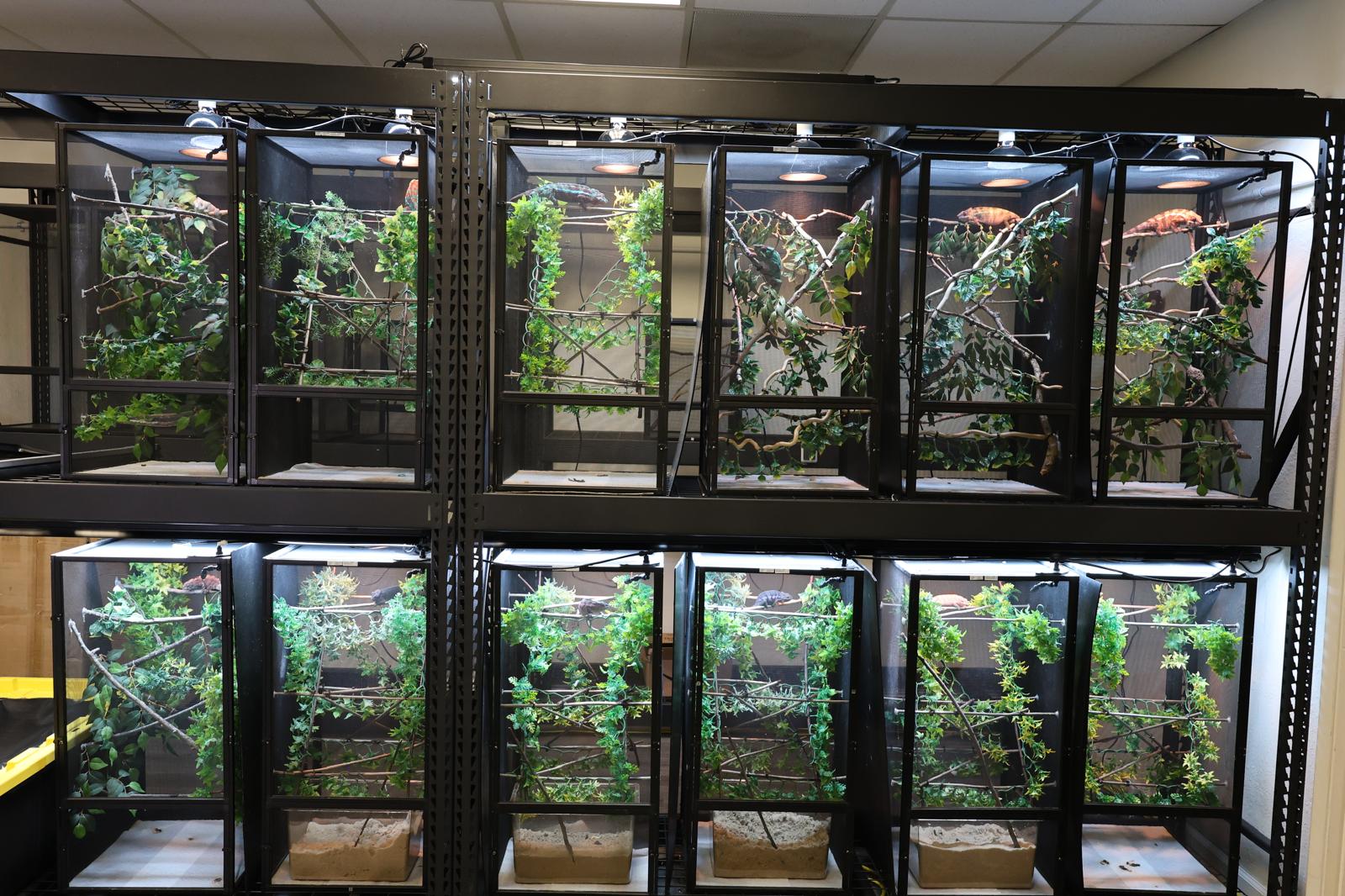
We do most of the work outside the cage's awareness. Pick out frass and shed feeders with long tweezers from the side panel; the animal rarely pays attention. Replace the drainage tray with a clean one in under sixty seconds. Wipe glass-front condensation with a microfiber, no spray, no scent.
Two-week deep-cleans are the only time the animal is asked to relocate. Move it to a clean grow-out cage with familiar perches, then break down and rinse the main enclosure with hot water alone — no soap, no quats, no 409. The chameleon goes back into the same cage with the same plant and the same branch in the same place. Routine is the goal.
DSQUARED Reptiles — Living Art. Curated Genetics.
From the field notes archive.
The morning baseline photograph.
A single weekly photo, taken at the same hour and angle, will tell you more about your care than any forum thread ever could.
Tightening screen tension on a year-old cage.
After twelve months of misting cycles and live plant weight, screen panels sag in ways that quietly compromise climbing surfaces.
A 72-hour gutload window for dubia roaches.
Dubia gutloads peak somewhere between 48 and 72 hours after the colony moves onto a fresh diet. Here's the schedule we run.