Hand-test every screen panel on every enclosure. If any panel flexes more than a centimeter under thumb pressure, re-tension or replace today.
Tightening screen tension on a year-old cage.
After twelve months of misting cycles and live plant weight, screen panels sag in ways that quietly compromise climbing surfaces.
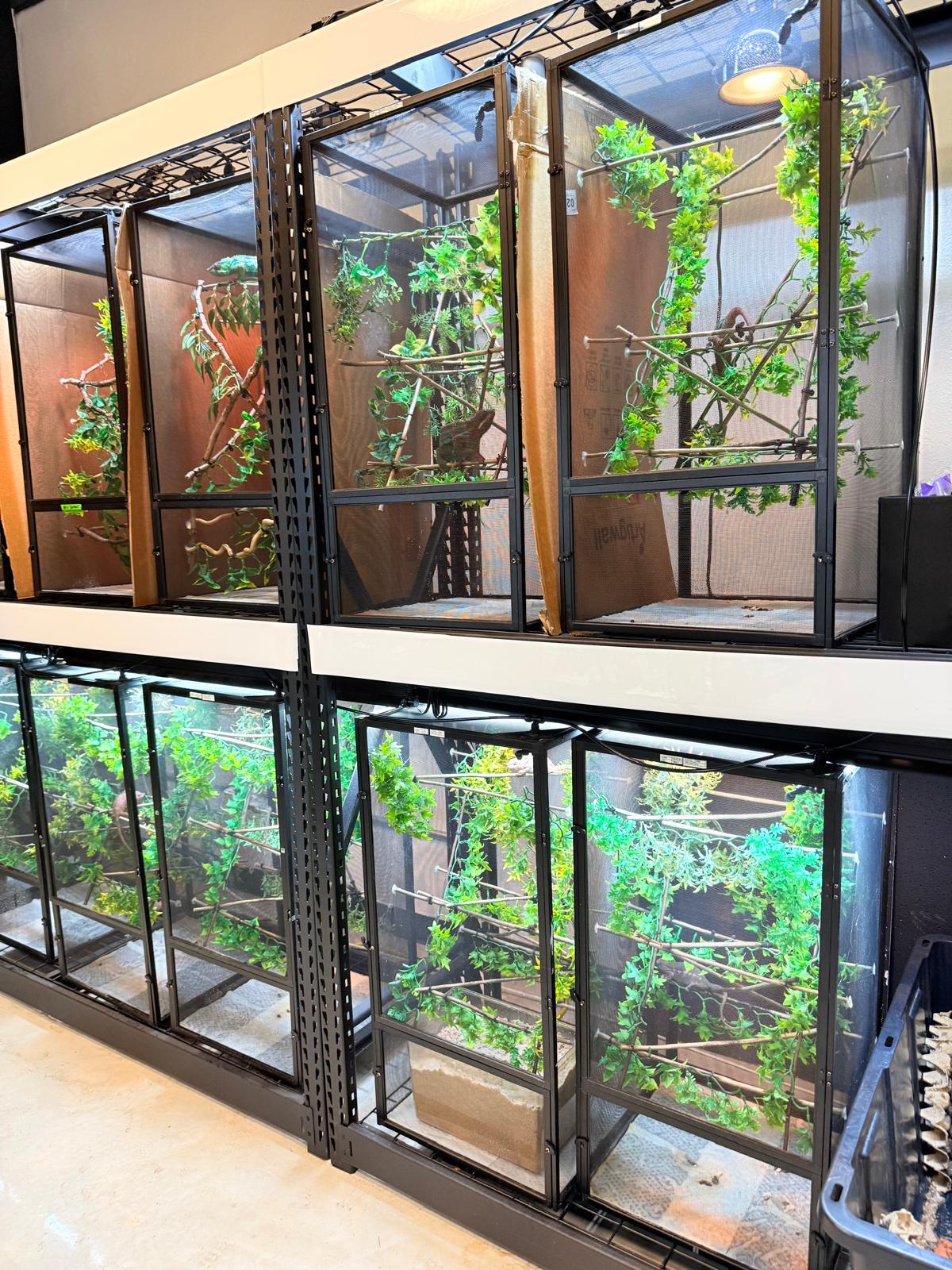
A panther chameleon does not climb a cage. It climbs a network of micro-anchors, and the screen mesh is part of that network the moment branches stop reaching every corner. Over twelve to eighteen months of daily misting, fogger condensation, and the slow downward pull of pothos vines, the screen sags.
The check takes two minutes per enclosure. Press a flat thumb against the center of each screen panel. A taut panel returns immediate resistance. A loose panel flexes inward visibly, and on the side panels you will feel the aluminum frame torque slightly with the pressure.
If the frame is square and the screen is intact, you can usually pull the spline with a small flathead, lift the screen, draw it taut by hand across the long axis, and re-seat the spline. Work in two passes per side — light tension, then full tension.
DSQUARED Reptiles — Living Art. Curated Genetics.
From the field notes archive.
Building a Ferguson Zone 3 UVI gradient.
Panthers want a UVI gradient running from roughly 0 in the deep canopy to 4 at the basking spot. The fixture choice and mounting matter more than the bulb brand.
Why we weigh every juvenile every Wednesday.
Grams do not lie. A juvenile that is gaining is a juvenile that is about to colour up. A flat week is the earliest signal you will get.
Mister, dripper, fogger: three tools, three jobs.
Each piece of hydration hardware solves a different problem. Run them at the wrong time and you wreck the gradient instead of building it.