Walk to your enclosure. Count the perches. If three or more are horizontal, swap one for a diagonal tonight.
Branch architecture: diagonals, not horizontals.
An enclosure full of horizontal perches trains a flat animal. The wild equivalent is a network of diagonals at every angle the foot can grip.
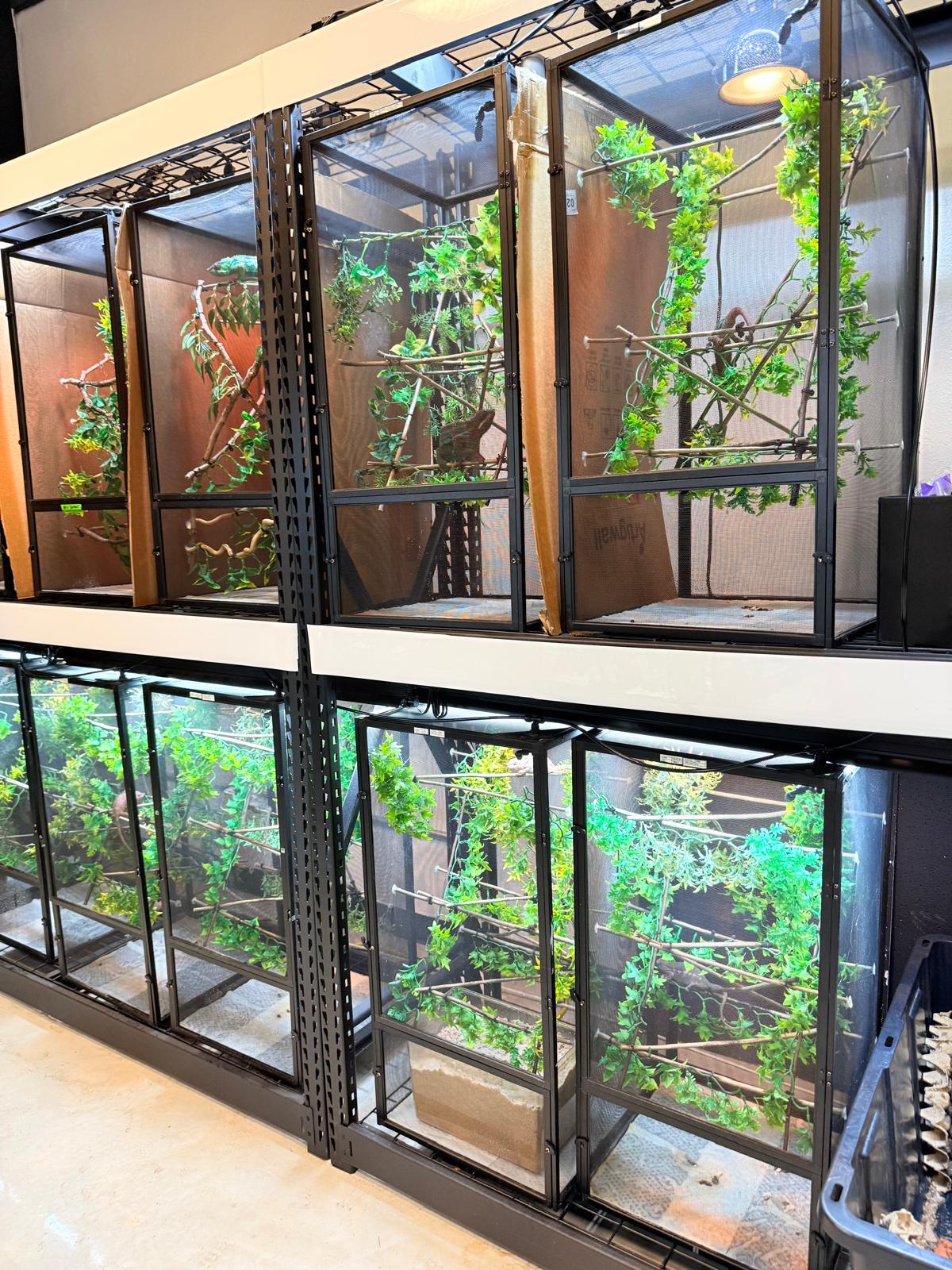
Most keepers, when they buy their first cage, install perches the way bookshelves get installed: parallel to the floor, evenly spaced, optimized for visual neatness. The chameleon then climbs the resulting cage along a single repeating geometry.
Wild Furcifer pardalis live in a tangled middle canopy. Diagonals everywhere. Perches that fork. Perches that descend. Perches that loop back on themselves. The foot sees a different grip angle every meter.
We build cage interiors to hit at least four perch angles between fifteen and seventy-five degrees off horizontal, with at least one perch that visibly continues into the canopy of a live ficus or pothos. Live plants are not decoration. They are perches you didn't have to install.
DSQUARED Reptiles — Living Art. Curated Genetics.
From the field notes archive.
Rotate the basking branch eighteen degrees this week.
A static branch trains a static animal. A small angular shift, repeated through the season, builds grip strength and joint articulation.
Reading basking behavior across the day.
A panther's daily activity follows a predictable arc. Deviations from the arc are the earliest behavioral signal the keeper has access to.
Branch diameter and grip development.
Grip strength develops on branches the foot has to negotiate. Too thin and the toes overlap; too thick and only the front toes bear weight.