Pick up a branch from your cage and wrap your thumb around it. If your thumb meets your index finger easily, the branch is too thin for an adult.
Branch diameter and grip development.
Grip strength develops on branches the foot has to negotiate. Too thin and the toes overlap; too thick and only the front toes bear weight.
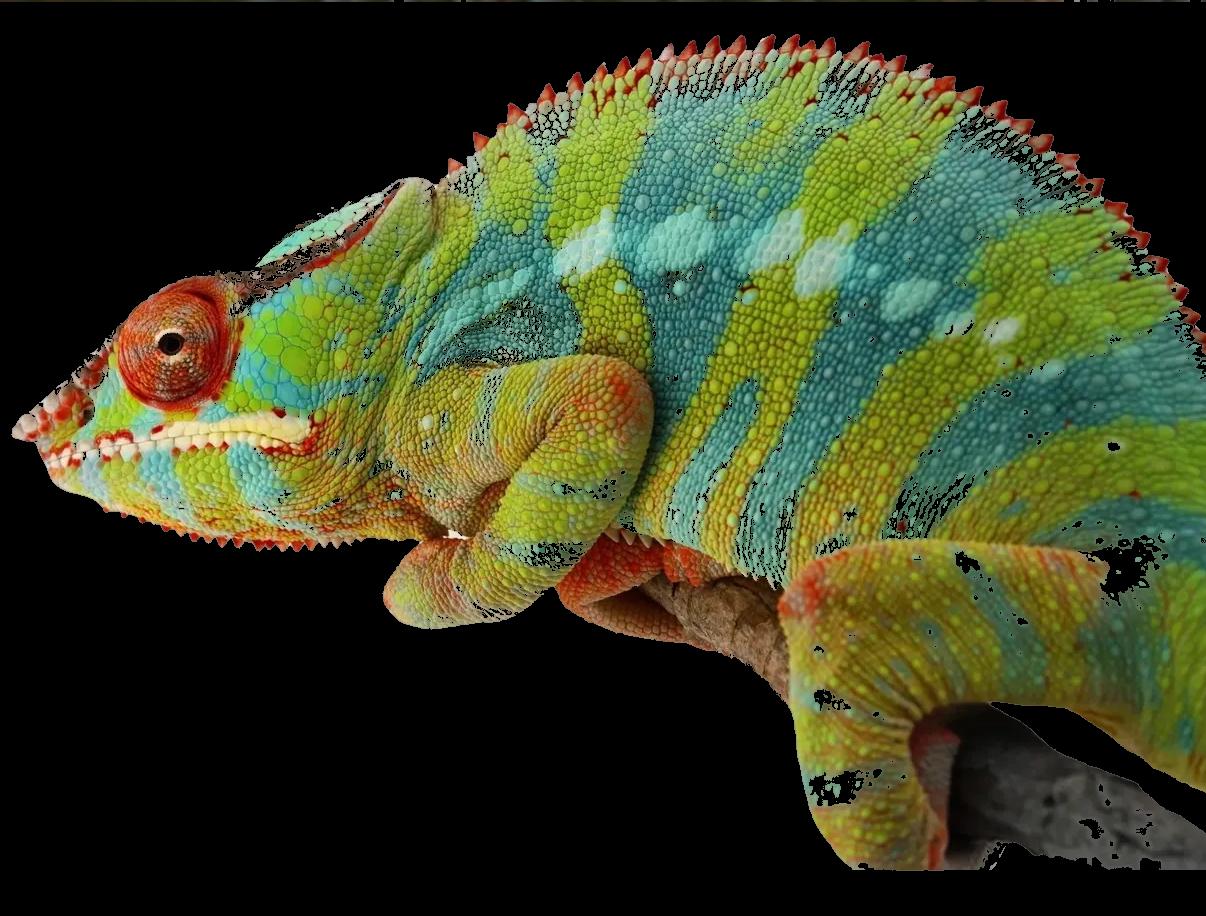
The right working branch diameter is just slightly larger than the chameleon can fully encircle with one foot. For an adult male panther, that is roughly the diameter of a thumb. For an adult female, slightly thinner. For a juvenile, the diameter scales down to roughly a pinky.
Vary the diameter across the cage. Some perches at the working diameter, some thicker for resting, some thinner for fast traversal. The foot adapts to what it grips daily — a single-diameter cage produces a single-grip animal.
DSQUARED Reptiles — Living Art. Curated Genetics.
From the field notes archive.
Rotate the basking branch eighteen degrees this week.
A static branch trains a static animal. A small angular shift, repeated through the season, builds grip strength and joint articulation.
Branch architecture: diagonals, not horizontals.
An enclosure full of horizontal perches trains a flat animal. The wild equivalent is a network of diagonals at every angle the foot can grip.
Reading basking behavior across the day.
A panther's daily activity follows a predictable arc. Deviations from the arc are the earliest behavioral signal the keeper has access to.